
Can you imagine working without enthusiasm, without energy, without effort... without desire? Can you imagine the impact of 90% of working people finding themselves in this situation in their workplaces? This is the reality presented by a new study conducted by the consulting firm Gallup, according to which, in 2025, Only 10% of the working population in Spain is committed to their work. And we already know that without this deep motivation and work connection, there is no development, no innovation, and no productivity.
By Lydia Vidal. The report State of the Global Workplace 2026, The report, which collects data from more than 140 countries and thousands of respondents, makes it very clear: the decline in the level of job commitment is global in scale. The figure that measures what in English is called employer engagement down for the second consecutive year, at 20%, and it is the Lowest level since 2020, When we are in the midst of the pandemic, we witness that silent widespread disengagement.
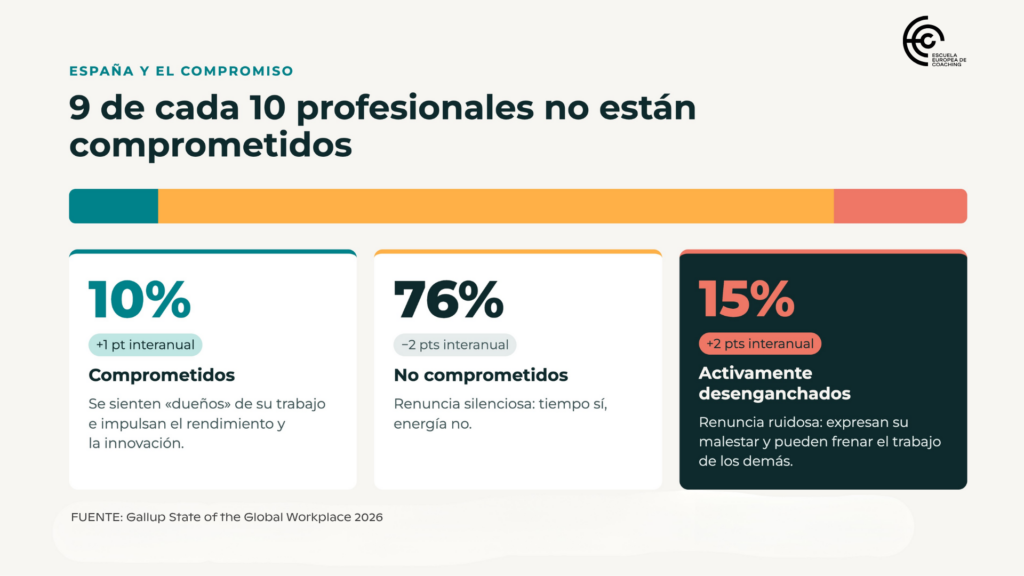
Spain is at the bottom of a region that already holds the last place. Europe is once again the region with the lowest commitment, with 12% (one point less than in the previous period), and Spain is still below: only 10% of its professionals are committed to their work. Three out of four (76%) are «not committed,» meaning they put time into their work but not energy. Another 15% are actively disconnected.
What is commitment and why it matters
Commitment is not an accessory or a luxury; it is a necessity; it is the involvement of each professional with their work, their team, and their company. From the HR function, it is not about employees being satisfied or «happy»; it involves achieving that they feel a deep and active connection with the purpose and goals of the organization.
And commitment, which is an individual feeling, depends on many organizational factors, including the sense of what is being done, opportunities for growth, recognition, relationships, or the work environment.
Understanding the study. Gallup distinguishes three levels of commitment and based on this groups the people surveyed:
- Committed («owners» of their work): They are the people who drive the performance, innovation, and advancement of the organization. They feel the project as their own and bring a differential value.
- Not committed (silent resignation): profiles that strictly follow their schedule and tasks (they put in the time), but do not bring energy, initiative, or passion. Their potential remains dormant.
- Actively detached (loud resignation): Those who openly express their dissatisfaction. Not only are they disconnected, but their actions and attitude can even undermine the work of their own colleagues.
The cost of disconnection
The difference between having profiles from one side or the other translates directly into the results and corporate culture, and the numbers prove it. The Gallup meta-analysis based on 183,806 respondents. teams. It details the achievements that are indeed achieved in the Teams that are more committed, Compared to those who are less committed, for example:
- 23% more in profitability
- 18% more productivity gains in sales
- 78% fewer absences, 63% fewer work accidents
- 21% fewer staff turnover (up to 51% fewer in sectors with a historically low turnover)
- 70% more people claim to feel that they are thriving professionally and personally.
Seen in this way, work engagement ceases to be a human resources metric: it is a driver of the global economy. According to the study, by 2025, the productivity lost due to lack of engagement reached 10 trillion dollars, about 9% of the world's GDP. (And this is a conservative estimate, because it excludes the costs associated with staff rotation, workplace accidents, theft and material losses, and health care expenses.).
What is changing: managers and AI
The report presented now highlights a particularly striking fact that appears for the first time in 2026: the decline in commitment among managers. Moreover, the commitment of those with leadership roles is the lowest, from 27% to 22% in just one year. And this is a novelty: being a manager no longer being associated with being more committed.
Furthermore, according to the study, those who lead have had quite bad days in 2025: they feel more stress, anger, sadness, and loneliness than professionals without a team in charge.
AI tests the implication. Commitment teams are better prepared for change and more successfully navigate uncertainty or crises, and today artificial intelligence may be the greatest of these.
Therefore, according to the report, the teams considered compromised will use it more and in a better way, while in the teams with lower motivation there is the risk not only of not using the technology as much, but also of using it in a «worse» way, even leading to security gaps emerging. Here too, the consequence of lack of involvement or low concentration becomes visible.
The fall is not inevitable
There are huge differences in the level of commitment depending on the teams and organizations, and the answer lies in how people are cared for and developed at all levels of commitment. Thus, in the Organizations with best practices, Almost 80% of managers are committed, almost four times the global average.
As for the index that measures the well-being Of the professionals, only one of the figures improves slightly: the 34% claim to prosper in their lives, one point more than the previous year. However, the majority (56%) still «struggle».
Negative emotions also remain above the levels before the pandemic: Four out of ten professionals feel stress for most of the day, and more than one in five of them live daily with sadness (23%), anger (22%) or loneliness (22%).
In Spain, daily anger reached 24%, three points more than in the previous period and nine above the European average. The pressure is even greater for those who lead: compared to professionals without a team in charge, they feel more stress (+7 points), anger (+12), sadness (+11) and loneliness (+10).
Well-being and emotions: a fragile improvement
But the 2026 report also provides a key insight: committed leaders experience these emotions less frequently and are 14 points more likely to feel that their lives are thriving.
Furthermore, well-being grows when people enjoy their work, feel that it improves the lives of others, and perceive that they have a range of choices. Commitment and well-being reinforce each other: taking care of one is taking care of the other.
Caring, accompanying, developing: three verbs to regain commitment
If commitment and well-being go hand in hand, the response cannot be limited to measuring or launching isolated initiatives. Caring for people is creating the conditions for them to find meaning in what they do, feel recognized, and have room to make decisions.
Accompaniment means being present in moments of pressure, change, or uncertainty, also for those who lead, who often support their team without anyone supporting them. And developing means giving each professional, and each leader, tools to manage their emotions, to communicate better, and to grow. None of these levers work alone, nor in the same way in all organizations. That is why, before taking action, it is advisable to ask yourself some questions.
Are you worried about the commitment in your team, the managers, in you?
First, the diagnosis. Then, the path. There are no two organizations that are alike, nor are there two teams with the same causes of disconnection. Before any intervention, in Escuela Europea de Coaching We follow a process in several phases. The first, of course, is listening and diagnosing the current situation; the next steps consist of defining the goal or ideal situation and the action plan to achieve it, with tailored interventions:
- Leadership-coach programs for middle managers and executives.
- Executive and individual coaching processes for professionals and leaders in times of pressure or change.
- Emotional management and well-being to prevent burnout and maintain the energy of teams.
- Support in the transformation and adoption of AI, so that change is lived with meaning and not in fear.
The data tell us that commitment is at its lowest point, but it is also not inevitable. Organizations that choose to care for, support, and develop their people, starting with those who lead, achieve More involved teams, More healthy and better prepared for the changes that are coming.
It is not about big gestures or isolated actions, but about a way of leading and relating that is trained and sustained over time, cultivating belonging, autonomy, and motivation from person to person, team to team, day by day.
Sources: Gallup (2026), State of the Global Workplace: 2026 Report