
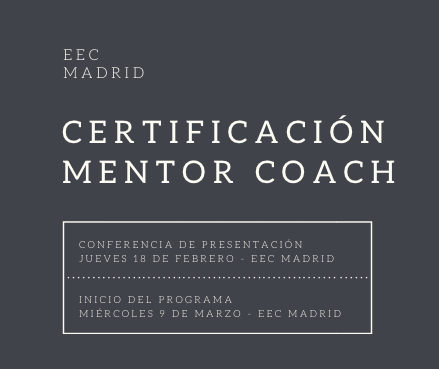
The Mentor Coach programme, which starts on 9 March at EEC Madrid, has been studied before its launch by the coaches and trainers of the EEC. A pilot experience from which we have already been able to learn lessons.
Aimed at coaches who are at least ACCs interested in working as mentor coaches, the programme is comparable to a master's degree in coaching in the detail and depth with which the 11 ICF competencies are worked on, so it is also aimed at professional coaches who are interested in mastering these competencies like the back of their hand.
FOUR QUESTIONS TO TRAINER ROSA ZAPPINO, CCP COACH
1. Does the programme have a double aspect, is it to work as a mentor coach and also to improve as a coach?
Yes, it is. It is a training programme for future coach mentors and, in that sense, the programme is based on developing the necessary competencies for the performance of this role through the deepening of competencies and the development of applicable tools to increase the degree of excellence as a coach. At the same time, the knowledge and experience that the student acquires, through the internships that he/she carries out in the programme, helps him/her to grow as a coach. This is something I have seen for myself and from the testimonials of the people who have attended the pilot course.
2. What methodology is used to work on the ICF competencies?
This is the characteristic methodology of the Escuela Europea de Coaching that has given us such good results in other programmes. We transmit knowledge through practice and experience, respecting the styles of each participant and encouraging participation to create a space of openness and trust.
From the outset, a learning community is generated, which means that the group is enriched not only by the programme's own activities, but also, and very importantly, by the contributions of the group itself. This is a course designed for experienced professionals, who have a lot to say. On the other hand, we hope that the people who enrol will come from different coaching backgrounds and form a powerful and diverse team from which we can all learn.
3. What does the participant who attends this programme achieve?
You achieve a qualification that enables you to work as a Mentor Coach, through the acquisition of the necessary competencies established by the International Coach Federation. ICF requires mentoring hours in its certification programmes and this is a new space that can mean an additional work opportunity for the coach.
4. Who can deliver this programme and what has it meant for the EEC?
The people from the EEC who teach this programme have been trained as Mentor Coaches, are PCC or MCC and have extensive experience as Mentor Coaches, as the School has been teaching the Mentoring the Coach programme since September 2013. For us it has meant developing a higher level of training in the coaching career, which was being demanded by coaches who have already been certified, have reached ACC level or higher, and want to continue advancing in their development. For the School it is a challenge, as it is the first programme of its kind to be held in Spain and a way of responding to this demand.
FOUR QUESTIONS TO THE STUDENTS, COACHES OF THE EEC
1. What has your experience been like as a student of this certification?
“It has meant a substantial change in the way I understand coaching, from a more concrete point of view, more useful for the coaching client”, Sandra Díaz Leonardo.
“It has been a productive experience professionally. It has helped me to enrich myself as a coach and to realise many areas of improvement that I had, and that from the first minute, I started to put into practice, seeing its fruits. I have found it to be a great product, it is a course that is at the same level as Cycle I and II and Team Coaching”, Emilio Arsuaga.
"The exercises carried out during the programme have allowed me to nurture a frame of reference for my analysis of the sessions I observe and carry out; I consider this framework as an observation tool that can be useful for me and for my colleagues", Carmen Mellina.
“The Mentor Coach course has given me the opportunity to incorporate new professional distinctions that have allowed me to expand and structure many resources and ways of doing things”, Mavi Catalá.
2. What do you take with you? What have you left behind?
“To deepen the coach's competences from the observable, to incorporate the competences of the Mentor-Coach and to improve the coaching sessions themselves through the feedback received”, Luis Miró.
"It has allowed me to incorporate an understanding of the ICF competencies in a more natural and rational way. Observing and reflecting on the observable behaviours that support and underpin the practice of the competencies has been key to challenging me in my performance as a coach", Carmen Mellina.
“A new way of doing. More than leaving behind, integrating another paradigm”, Patxi Rocha del Cura.
“What I value most for my personal and professional development has been the in-depth work with expert coaches. Intense and very valuable training at this point in my coaching career”, Sandra Díaz Leonardo
“I take with me having integrated the ICF model, with the intention of not moving away from my own style of coaching. Fundamentally, I have discovered everything that the second competence, Coaching Agreement, has given me”, Emilio Arsuaga.
3. What you have learned or unlearned, how did you learn it?
“Thanks to the method, and above all to the online group sessions”, Patxi Rocha del Cura.
“As always, practising”, Emilio Arsuaga.
“I would highlight the online sessions, which have been very productive and make attendance easier due to their flexibility. In this sense, the tool used for the online sessions is very intuitive and the attention received to solve the smallest difficulties is sensational”, Luis Miró.
"The programme is also designed to ensure and enable us to deepen our session delivery and observation skills through learning and support groups that are based on sharing ideas and reflections that generate higher learning," Carmen Mellina.
4. Who do you recommend this programme to and why?
“To former students, above all to further professionalise our activity”, Patxi Rocha del Cura.
“To any coach: to improve as a coach and to open up a new space for professional development, the Mentor Coach”, Emilio Arsuaga.
“To all those professionals who want to improve and professionalise their development and skills as coaches”, Mavi Catalá.
- The introductory talk will be held on 18 February by Rosa Zappino (PCC) and Silvia Guarnieri (MCC).