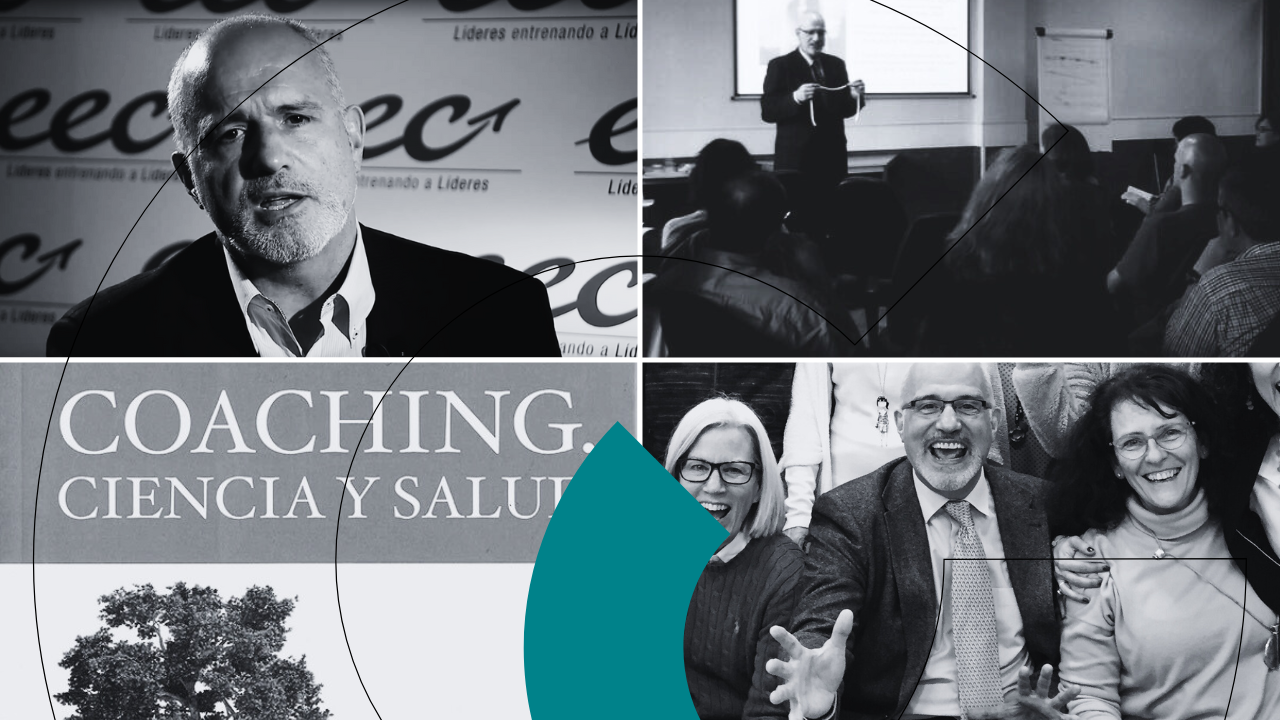
After more than 15 years of dedication, Francisco Junquera, MCC and leading trainer at EEC, bids a professional farewell to Escuela Europea de Coaching. His legacy is written in hundreds of coaching processes, classrooms full of inspired students and a firm bridge between science and human development, visible in the design of a programme and in his book Coaching, Science and Health.
In this interview we review his journey and celebrate the impact he has left on so many people who, thanks to him, today look at the world with a wiser, more aware and more compassionate gaze.
Do you remember the moment you discovered coaching?
It was during the early 2000s. I was working in a multinational pharmaceutical company and the head office in the USA offered us managers an "innovative training programme in coaching". I signed up because I felt very attracted to these topics.
What attracted you to decide to dedicate yourself to this discipline?
Although my academic background gave me a more scientific profile, I have always had humanistic concerns and the discipline of coaching seemed to me to be a very powerful way to help the professional and personal growth of others and myself.
What has it meant for you to be part of Escuela Europea de Coaching?
I have felt privileged to enjoy a professional and personal well-being that is very difficult to find in companies.
What has been your biggest learning experience as a coach?
That "the expert is the other" has always been and still is the greatest learning.
What did obtaining the MCC credential mean to you?
It was a transformative experience, a self-realisation and an opportunity to strengthen my skills as a coach. [MCC is the credential of having completed 2,500 hours of individual coaching and passing a comprehensive ICF test].
You have been a pioneer in building bridges between science and coaching. Why do you think this approach is important?
Science is something that is written in chapters and each new chapter cancels or modifies the previous one. The 21st century has given us new scientific paradigms (Epigenetics, Neuroscience, Psychoneuroimmunology, Behavioural Medicine, etc.) to show us that there is a strong connection between thoughts and human physiology. ) to show us that there is a strong connection between thoughts and human physiology that challenges our traditional paradigm.
My experience over the years with health coaching has confirmed to me that thought and speech are a form of life energy which has the ability to interact with the organism and produce profound physical changes.
I am convinced, for example, that there is an intimate relationship between our beliefs (or thoughts that we assume to be true) and our immune systemand that the two constitute an integrated and inseparable system of defence against pathogens. It could be said that a healthy person is one who has healthy thoughtsAnd coaches know that the healthiest thoughts are achieved through a process called "change of observer". So I think coaching has an exciting task ahead of it.
If you had to sum up the relationship between wellbeing, coaching and neuroscience in one sentence, what would it be?
I am convinced that coaching is a great methodology to support wellbeing physical, mental and spiritual, and neuroscience provides the scientific basis to prove it.
How did the idea for the "Coaching, Wellness and Neuroscience" programme come about? What did you want to contribute to this training?
I would say it was born many years ago when I have been doing DNA research at the Institute of Medical Chemistry, CSIC. These scientific interests later led me to follow the Human Genome Project (PGH) (1990-2003), an international scientific effort aimed at deciphering the genes of human DNA, i.e. a kind of map of all genes.
Following PGH, the science of Epigenetics expanded our understanding of how this genetic material is used and regulated in normal and pathological conditions, and began to explain when, where and how these genes are turned on or off.
It began to be discovered that there are a number of epigenetic or environmental influences such as nutrition, exercise, emotions, our limiting beliefs, stress, lifestyle, etc., that directly impact our bodies. The truth is that these influences related to emotions or the unconscious I didn't fully understand, but I found it a fascinating topic.
So during the years 2001-2003 I decided to do a master's degree in Psychoanalysis at the UCM to study the physiological mechanism of the mind, and in 2006 I entered the world of coaching. I have seen, first in myself and then in my coachees, that a coach can accompany the client to take responsibility for those epigenetic influences that directly interfere with their health and well-being.
So, with all this pupurrí I had in my head, I decided to organise my ideas and share them. This is how this training programme was born, initially called "BCO (Biology of Changing Observers") and later on "BCO (Biology of Changing Observers)". "Coaching, Wellness and Neuroscience"..
After all this journey, what mark would you like to leave on the EEC, on your students, on your clients?
The trace of having been able to improve their lives in some way.
What message would you leave for those who are just starting out on their coaching journey?
Patience, perseverance, not being afraid to ask for help, being open to learning and believing in yourself.
Is there anything you will continue to explore, learn or share?
Spiritual health
With what words would you like to say goodbye to the EEC community?
With a "see you always".
What would you like us to always remember about Kiko?
Hugs.
Interesting videos
Francisco Junquera explains the Curar-Sanar Distinction
Francisco Junquera on the pioneering Observer's Biology of Change programme