
- Your name: Verónica Gamero García.
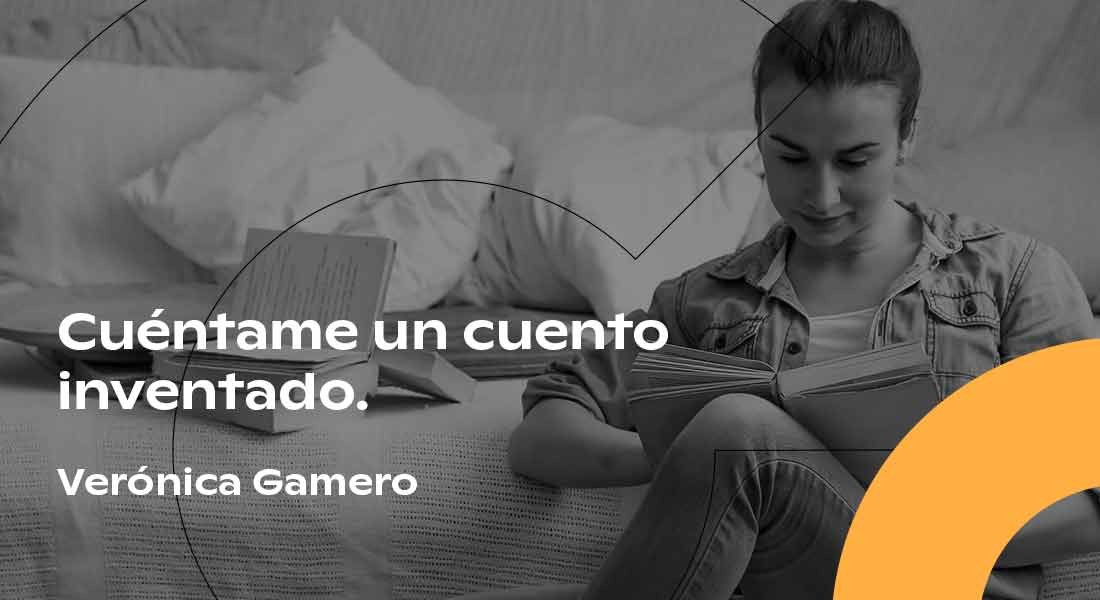
- Title of the book: Cuéntame un cuento inventado.
- Author: Verónica Gamero - Illustrator: Jessica Gázquez.
- Publication date: 19 March 2022.
1. What did you use this book for? What did you like most about the process?
With all my vulnerability, I share with you that this book was the result of the mandala I made in EEC at the beginning of cycle II. In the centre of my cardboard, I drew a book with wings and a powerful creed that shouted "I can, I can, I can", directed at my fears and my limiting beliefs about the idea that this book project would never see the light of day or that it would paralyse me in front of publishers or large audiences the day I had to present it publicly.
In the spring of last year the book became a reality and, since then, I have toured cities and broadcast media. I have spoken to audiences large and small, in person, in webinars, on radio stations and social media, without fear of my voice not being heard, without fear of lack of credibility or lack of recognition. Empowered. I managed to go from dream to vision and this is how I presented it to Rosa Zapino and my classmates, now great friends, three years ago.
2. What learnings from the book are most relevant to the way you experience coaching?
This book begins with a "what for": to ground readers in the universe of the world of children, giving keys to teach how to speak the language of children, to learn how to develop creativity and divergent thinking, not only of the child, but also of the adult who walks alongside them.
To this end, in the book I propose that we dare to break cultural, social and behavioural barriers, to move from the rational to the irrational, to experiment, play, sing, dance and create without limits and without fear, based on curiosity.
And, as the person we are accompanying discovers the world, let us do so at their side without guidance or control, let us be infected by their capacity to marvel at what our senses present to us and at what is yet to come.
3. Any time of insight during your reading?
In many moments of the book I feel disconnected from the noises of "adult in possession of wisdom and truth". I turn off my internal radio to initiate the process of limbic resonance with the other person. I abandon the illusion of "control" and look from love.
A good storyteller is a good "hunter" of stories, and for that you have to learn to look at the world with different eyes, with the eyes of a child.
On each page, I propose to discover the child in us, the child who ceaselessly seeks beauty and marvels at what he or she finds... the one who shouts, sings and dances.
In each chapter, you learn to dance to the beat of the other and to vibrate with him. I share with you an example from the book:
"What parent hasn't come home to a makeshift teepee in the living room built from the satin sheets and exquisite velvet blankets we treasure in our homes. And it is at that precise moment, while still wearing our perfect mother or father costume, that we hear his mischievous voice calling us from the shelter to come in and play Indians. We start to doubt whether a scolding or a punishment would be better. But for once try to be quiet: Take off your shoes, drop your bag or your tie, trace war paint on your cheeks with lipstick and crawl into their world and once you're in there, look into their eyes... and invent. Hang on the hanger the mediocre you consider your day has been or the slovenliness you guess tomorrow will bring and play at imagining with your children. Now. And right there, right under your nose, you will find happiness. Pure."
4. What tools from the book can be used in a coaching process?
Through storytelling and inspiration, we can learn to let go of control, to vibrate with the other and to look at them with love.
Through metaphor, we delve into how to listen, how to look at the world and the person in front of us in order to discover it with wonder; we work on uncertainty; we cultivate creativity and divergent thinking to see the world through different eyes.
We also look at how to make up stories using people and situations from the listener's life to introduce them as ogres and princesses in order to deliver subliminal messages that reach directly through the right hemisphere.
And of course, we train the art of storytelling.
5. At what point in the learning process as coaches might it be advisable to read it?
Training in the use of tools such as metaphor or storytelling can help us at any time to be aware of our empathic listening and our silences and also teaches us to train patience and a loving and kind look towards the coachee.
On the way to learning how to create context, I would highlight its impact on the dance in the session, to abandon control, to feel the magic and to realise that it is not always easy.
Among the stories that have helped me in some processes to raise the awareness of my coachees I would highlight:
- "The Shadow Child" and "An Invented Sea": to confront limiting beliefs and overcome fears that block us.
- "Mama flies with me": to learn to love, to let go of control, to let go of demands, to live in the present, to be occupied and not pre-occupied, to listen empathetically, to let go, to dance with the other...
- "Sandiluchi and Pericheta": to get rid of prejudices and labels and train the ladder of inferences and the very disruptive change of observer.