

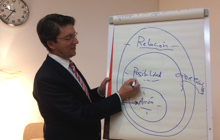
The relationship between the methods employed by coaching – asking open-ended questions and practicing active listening – and how to be a conscious leader were some of the topics addressed at the “Conscious Leadership” conference, organised by the management of the Beta Gamma Sigma Spain association, through Elisa Villar and Isabel Córdova Samaniego, and the European School of Coaching, in Madrid, represented by its Director of Alumni and Corporate Development, Juan Luis Ayuso.
The presentation allowed for reflection on the impact that relationships have on business and how “leaders should generate productive conversations to achieve results in their organisations.”
“Leaders are made in a relational environment, and they are at the service of their teams” and to do so “they must be aware of their strengths, weaknesses, and that their emotions are contagious and compromising. The key is to open up networks of conversations, and to do so efficiently they must learn to ask and listen to their team members,” assured Juan Luis Ayuso during his presentation. “There are different types of conversations: for action, for possibility, for relationships, but they all must find their opportunity,” he continued.
Ultimately, talking about “conscious leadership” means that leaders see executive coaching as a tool to connect with their environment and facilitate the realisation of their vision for their organisations to be shared and executed by their teams, explained the EEC coach.
Beta Gamma Sigma Spain is an honour society founded in the United States in 1913. Membership of this association is the highest recognition accredited by the AACSB that a business school student can receive worldwide. It currently comprises more than 750,000 professionals, of whom more than a thousand are in Spain.
The European School of Coaching is a company dedicated to the training and coaching of individuals who wish to work as professional coaches. In the business sphere, the EEC collaborates with organisations seeking cultural and developmental change through the skills and competencies of executive coaching.
The EEC began its journey in Madrid in 2003 and currently has a presence in Spain, Italy, Portugal, as well as Latin America.