

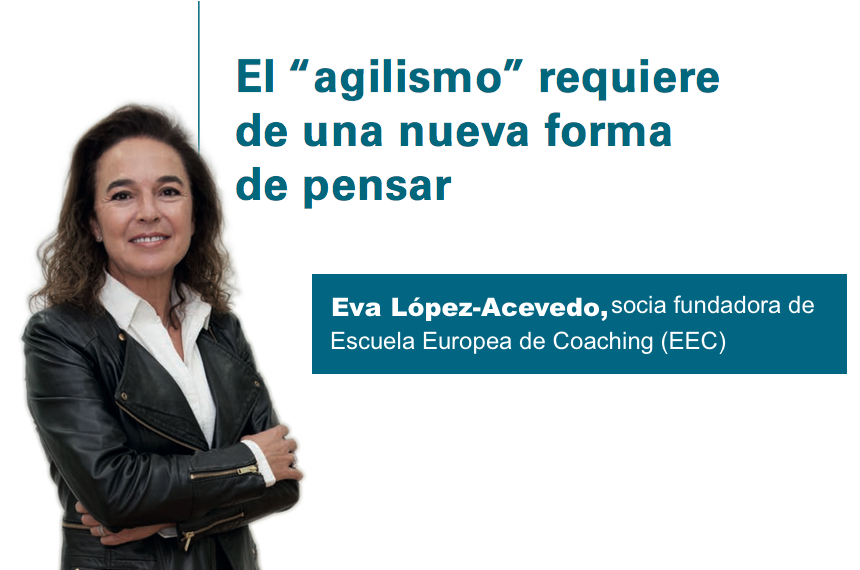
Increasingly, companies are turning to agile methodologies to drive innovation and respond more swiftly to their customers. Consequently, these companies are taking the step to blur their organisational charts, give more weight to self-regulating teams, and find themselves needing to incorporate conversational and coaching skills to ensure smooth operation between teams and objectives.
What characteristics do companies that introduce agile methodologies have?
Organisations adopting these methodologies are committed to a model that requires fewer managers and more shared, collaborative, and participatory leadership, as well as a new way of relating. In these agile environments, individualism and the fear of trying and making mistakes disappear, replaced by the value of questioning how things have been done. It's a commitment to multidisciplinary collaboration that eradicates competition between professionals or departments. All these changes in the way of working will not bear the fruit they could without the development of specific new skills and competencies that promote the building of self-regulated teams and a collaborative culture. I would go further, “agilism” requires a new way of thinking. Fostering shared commitment, making effective decisions quickly through alignment rather than consensus, trusting in others' capabilities, daring to show vulnerability, giving and asking feedback to embrace error and continuous learning are some of the indispensable skills for this new way of working.
In this scenario, what can coaching contribute?
In our experience, the agile environment forces us to pursue excellence rather than exigency, which is a very powerful coaching distinction. For years, we have been helping clients overcome the idea, even the culture, that we have to be perfect, that we have to answer everything, or that the more self-sufficient we are, the more we will be valued. Agile models are closely linked to many of the lessons that coaching generates: having better conversations to coordinate actions effectively, training in listening, broadening the way we observe, becoming systemically aware in order to interpret the organisation or the team as a system that regulates itself according to the objective, separating Being from Doing and not getting attached to an idea or product by confusing it with “who we are”, and feedback, lots of feedback. An agile team needs a lot of the mirror that gives feedback to detect errors on the fly that allow continuous learning and the progress of its project.
So, now more than ever, is it crucial to know how to work in a team?
Indeed, the rapport, coordination, and trust established in high-performing teams are the same that organisations, teams, and individuals require in agile environments. To be a team, the people forming it must trust each other, commit to achieving a common outcome, and set certain rules for functioning. And, of course, their actions must align with their commitments. This is all what we train through team coaching. The novelty is the speed. To move at the pace demanded by the market, it is essential to learn at the same rate. That is the advantage of an agile team, the speed at which it learns from its mistakes, reconfigures itself, and gets back on track.
What specific training does EEC propose?
For companies, as always, ad hoc. And as a new addition to our training programmes, we have designed a team coaching programme for agile teams, Team Coaching for Agile, aimed at experienced Scrum Masters and Agile Coaches, to reinforce the skills inherent to agile working: effective conversations, trust, commitment, empowerment, action coordination, vulnerability, motivation, and feedback. In short, coaching skills to drive talent, creativity, team strengths, and therefore, their results.
Finally, is agile understood as a methodology in the EEC?
In our experience, it is people who are agile, not processes. As clearly stated in the Agile Manifesto of 2001, Agile is a set of beliefs that enables a team to operate and make effective decisions on a specific project in order to rapidly deliver a product tailored to the changing needs of the customer. Therefore, we believe that "agilism" is not a methodology, nor a specific way of developing a product or service, nor even a work process. Without the right mindset, and without the feedback that follows listening, agile methodologies are neither effective nor make sense, as they must be built on the trust and commitment that arise from systematic feedback and feedforward. Only then are speed, learning and continuous improvement achieved.
TEAM COACHING FOR AGILE
Soft skills to successfully apply agile values and principles.
New training programme in Madrid. Content:
- Conversational differences in ceremonies of an agile project
- The systemic laws of team cohesion
- The keys to team self-regulation
- Tools for positive conflict resolution, overcoming obstacles, and taking on commitments and responsibilities with confidence
- Ability to sustain focus on the end product and deliver the expected results